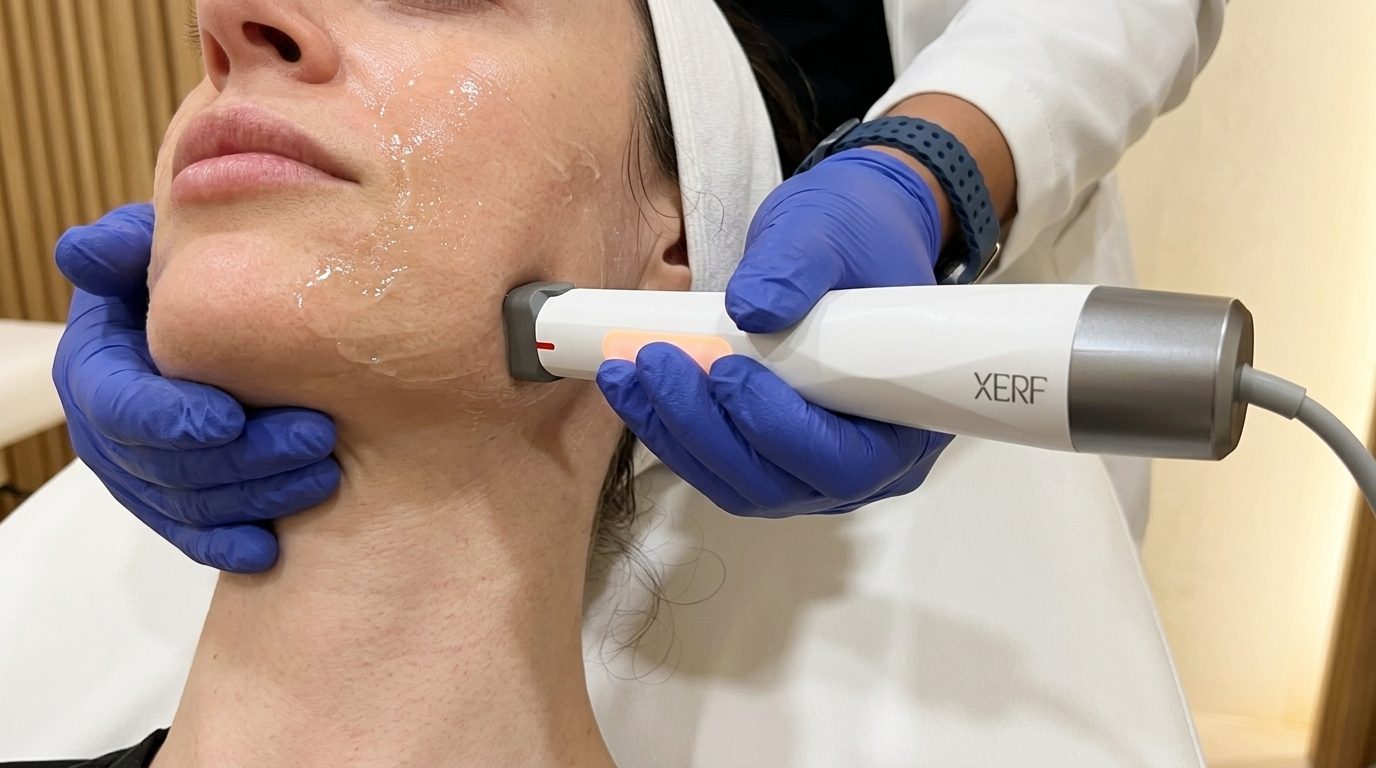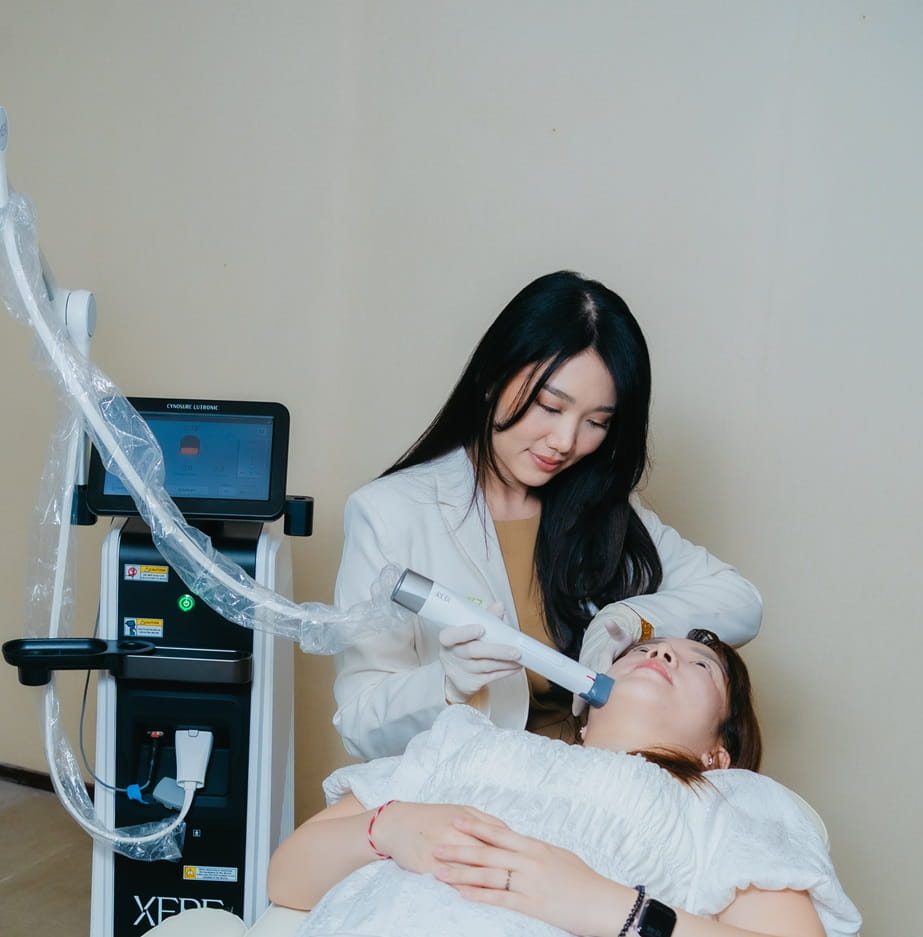
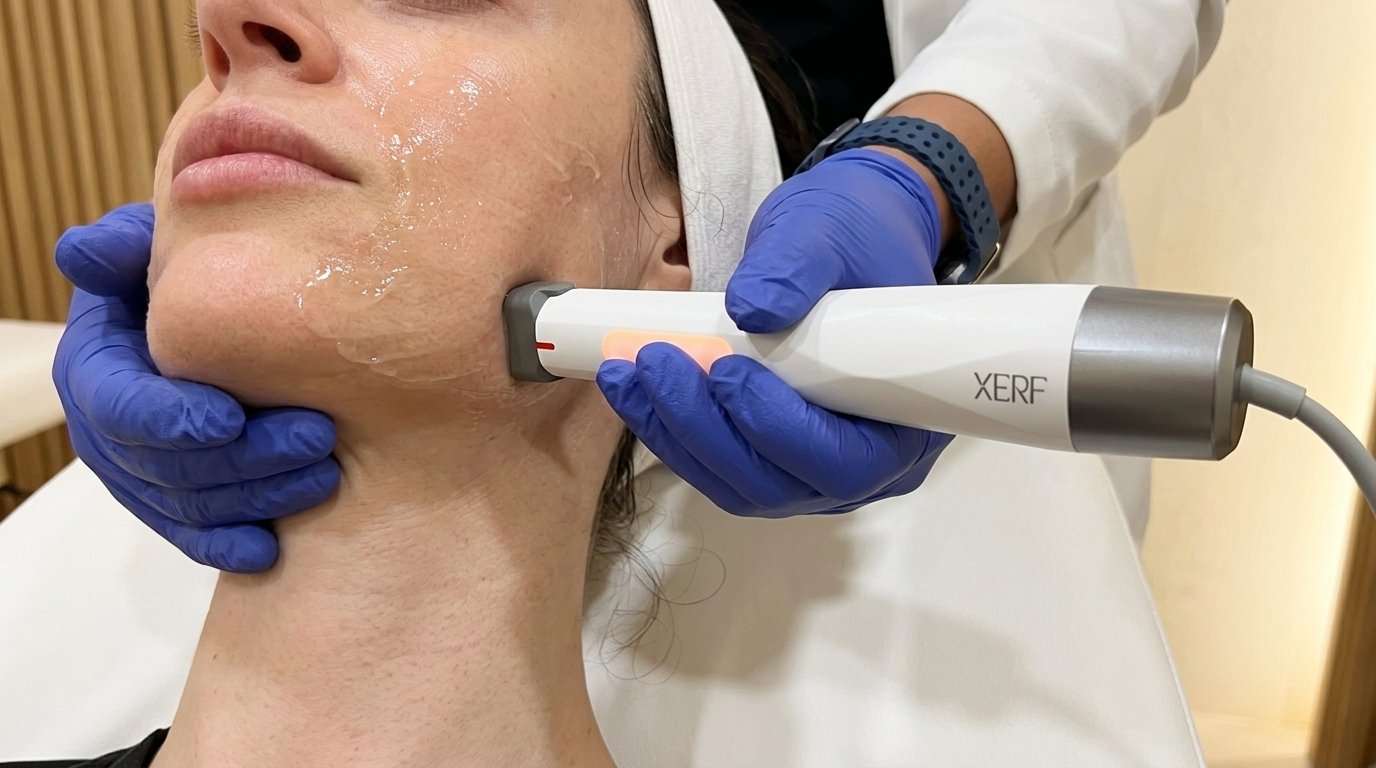
The XERF vs Thermage question comes up because both are non-surgical skin tightening treatments built on radiofrequency (RF) energy. A handpiece warms the deeper layers of the skin while, according to the manufacturers, the surface is cooled. The heat prompts collagen remodeling, the slow process in which the body breaks down and rebuilds the collagen that gives skin its firmness. The two devices are close relatives, but they are not identical.
So which one gives better results? No published study has compared them head to head, so neither can honestly be called the winner. The US FDA record for XERF reports that its heating and cooling behavior matched Thermage FLX in tests on excised skin, and it states that no clinical tests were included. Your own result will depend more on your degree of skin laxity, the treatment area, the settings used and how your skin responds than on the name of the machine.
Below, we cover how each treatment works, what the evidence shows and what to weigh before you choose.
XERF vs Thermage: What Is the Main Difference?
The main difference is how the two devices deliver radiofrequency energy. XERF combines two frequencies, 6.78 MHz and 2 MHz, in a single shot, which its manufacturer says heats tissue at more than one depth. According to Lutronic, the 6.78 MHz frequency targets the dermal layer, while the 2 MHz frequency penetrates deeper to reach the SMAS layer (superficial musculoaponeurotic system), the layer of muscle and connective tissue beneath the skin that supports the face. Thermage FLX uses one frequency, 6.78 MHz. Whether this difference leads to better results in patients has not been shown.
Here is how they compare on the points where reliable information exists:
Technology
Both are monopolar RF devices: current passes from a treatment tip through the body to a return pad, and the tissue's resistance to it produces heat. XERF, made by Lutronic, was cleared by the FDA in August 2025 (K251327). Thermage FLX, made by Solta Medical, was cleared earlier. When the FDA reviewed XERF, it used Thermage FLX as the reference device to confirm that XERF works in a similar way.
Energy delivery
Lutronic describes XERF as delivering both frequencies in one pulse through a patterned tip meant to reduce uneven heating at its edges. Thermage FLX delivers a single frequency through tips of different sizes.
Intended tissue targets
Lutronic says its two frequencies heat at more than one depth, including the fibrous septa, the thin connective bands under the skin that help hold it in place. Thermage FLX heats tissue down to the deep dermis. According to Lutronic, XERF's 2 MHz frequency reaches further, down to the SMAS layer.
Skin concerns addressed
Both are used for skin laxity, meaning looseness or loss of firmness, typically mild to moderate. The FDA clearance for XERF is worded around "electrocoagulation and hemostasis" of soft tissue, and the manufacturer explains that tightening is the effect of that soft tissue coagulation. A clearance describes what a device is legally cleared to do. It does not rank one device against another.
Treatment duration
Session length depends on the area and tip size, and no reliable source compares the two.
How Does XERF Work?
XERF is a monopolar RF device from Lutronic that delivers 6.78 MHz and 2 MHz energy together in one pulse. It launched in 2024 and received US FDA clearance in 2025.
The intended mechanism is shared with most RF tightening devices. Controlled heat is thought to make existing collagen fibers contract slightly and to trigger new collagen production over the following months, the process called collagen remodeling.
The reasoning for two frequencies is that lower frequencies are expected to travel deeper than higher ones. Lutronic says this lets XERF warm both upper and deeper tissue, including the fibrous septa, in one pass. This dual-depth design aims to tighten both the skin and the supporting structures beneath it in a single treatment.
As a newer device, XERF has a shorter research history than Thermage. Early published studies have focused on short-term results, and research on the device is ongoing.
For a suitable patient, the realistic aim is a gradual improvement in firmness and in the look of mild to moderate laxity. XERF is not a replacement for surgery, and no one can promise a permanent result or a surgical-level lift.
How Does Thermage Work?
Thermage is a monopolar RF treatment from Solta Medical, and Thermage FLX is the system discussed here. It delivers 6.78 MHz energy through a handpiece with interchangeable tips. Solta describes each pulse as paired with surface cooling and vibration. These are manufacturer descriptions, and earlier Thermage generations differ in specifications.
The aim is the same as for XERF: controlled heat that stimulates collagen remodeling and, over time, firmer skin, typically in patients with mild to moderate facial laxity.
Thermage has the longer published history. A review of more than 600 treatments with an earlier Thermage system (Weiss and colleagues, Journal of Drugs in Dermatology, 2006) reported mostly short-lived redness and swelling and no permanent side effects. That study used an older device and reported no measured tightening figures, so it speaks to safety more than to the performance of the FLX model.
Newer technology does not automatically produce better outcomes, and a longer track record does not make Thermage the stronger option either.
XERF vs Thermage Results: Which Treatment Works Better?
The available evidence does not show that either treatment consistently gives better results. There are no head-to-head clinical trials, and the XERF FDA submission rests on laboratory testing instead of patient outcomes. Both are used to firm skin gradually in suitable patients, and the better choice depends on the person.
In the FDA submission, sensors placed 3 mm deep in excised skin showed heating and cooling curves equivalent to Thermage FLX. That supports the claim that XERF behaves like its predicate, which is what the clearance pathway asks for. It does not show that either device tightens living skin more than the other. Clearance is not proof of clinical superiority, and a theoretical treatment depth is not proof of a stronger lifting effect.
What does shape the outcome of either treatment:
- Baseline skin laxity and facial anatomy
- The treatment area and the treatment protocol
- Device settings and the provider's technique
- Your individual collagen response
- Age, skin condition and lifestyle
- Realistic expectations and follow-up care
Some people see a slight tightening soon after treatment. This early effect may reflect temporary swelling and heat-related contraction, and it is not the final result. Collagen remodeling continues for months, and the timeline varies from person to person.
How Long Do XERF and Thermage Results Last?
Nobody can give a reliable figure for either device. Results develop over months, and how long they last depends on your age, skin quality, lifestyle and how the treatment was delivered.
Three stages are worth separating: the time to notice a change, which can be weeks for some people; a period of continued improvement as collagen is rebuilt; and the duration of the overall result, which fades gradually because skin keeps aging after any treatment.
For XERF, the published follow-up windows are short, about three months or less, so longevity beyond that is unknown. For Thermage, a physician who discloses a consulting role with Solta described results developing over four to seven months and lasting one to three years after one session in a 2018 conference talk. That account gave no study data, so treat it as a claim and not as a measured outcome.
Any maintenance schedule a clinic recommends is a professional judgment and not a proven standard, so ask what it is based on.
Is XERF or Thermage More Comfortable?
Neither can be called more comfortable on current evidence. The devices have not been compared in the same patients, and discomfort varies with the person, the treatment area, the energy setting and the technique.
Both use cooling. Lutronic describes XERF as comfortable without numbing, which is a marketing claim, and says it uses integrated cryogen cooling. Solta pairs Thermage FLX pulses with cooling and vibration and lists mild to moderate pain as the most common effect during treatment.
Bony areas can feel sharper with RF devices, and clinics differ on whether they offer numbing cream. Ask what is used, and treat any promise of a painless treatment with caution.
Is There Any Downtime After XERF or Thermage?
Both treatments are generally described as having little downtime, and most people return to normal activities the same day. Temporary redness is the most common reaction.
For Thermage, the 600-treatment review above found redness and swelling usually lasting under 24 hours, with swelling lasting up to a week in six patients. Temporary effects such as small papules, a surface crust or a cheek depression occurred in 2.7% of treatments and settled within about a week. That review used an earlier system. Solta states that redness typically settles within a day and swelling within about five days, though it can last longer.
For XERF, published studies report redness and mild swelling settling in one to two days, but the authors call the work preliminary.
Non-surgical does not mean risk-free. Burns, blistering, nodules and uneven contours are possible with any RF device, even if uncommon, and recovery differs between patients. Follow your clinician's aftercare instructions, and contact the clinic if something does not settle as expected.
How Much Do XERF and Thermage Cost?
Prices cannot be compared fairly from the outside. Cost varies by location, treatment area, number of shots or pulses, device generation, provider and treatment plan, and quotes from different countries are not comparable. This article gives no Thermage prices because none can be verified for a single market.
When you ask for a price, ask what it covers: which areas, how many pulses, whether a single session or a course is assumed, and whether a review visit is included.
Who Is a Better Candidate for XERF or Thermage?
Suitability depends on your skin laxity, treatment goals, medical history, anatomy and expectations. Both treatments are generally considered for mild to moderate laxity, and neither is a rigid fit for an age group.
XERF may appeal to people who want a treatment described as comfortable with little downtime and are happy to choose a newer technology with a smaller body of published evidence. Thermage FLX may appeal to people who prefer a technology with a longer track record in the literature. These are tendencies and not rules.
If your skin hangs well below the jawline, RF tightening may not be enough, and a surgeon's opinion is worth seeking. A qualified medical professional should examine you before treatment and talk through contraindications and risks. These can include pregnancy, a pacemaker or other implanted electronic device, metal implants in the treatment area, recent filler, active skin infection and a history of pigmentation problems, along with alternatives and realistic outcomes.
XERF vs Thermage: Which One Should You Choose?
Neither treatment is the universal winner. XERF adds a second frequency and has a short evidence history. Thermage FLX uses one frequency and has a longer one. Neither has been shown to beat the other in patients. A practical way to decide:
- Your goal. Mild overall loss of firmness suits both. Pronounced sagging needs a medical opinion about whether RF is enough.
- Comfort. Ask how each treatment is made comfortable at the clinic and what happens if you find it too intense.
- Budget. Compare what each quote covers, not only the headline number.
- Evidence. Decide how much a longer published record matters to you, and ask the practitioner what the evidence for their device actually is.
- Medical suitability. Your history and anatomy can rule a device in or out.
If you are unsure, a consultation is the most reliable way to choose, because a practitioner can examine your skin and explain the settings and number of pulses they would plan. Readers interested in learning more about the treatment, its potential benefits and the consultation process can explore our XERF in Bali treatment page.
Frequently Asked Questions About XERF vs Thermage
Is XERF better than Thermage?
There is no evidence that it is. The two have not been compared in patients, and the XERF FDA submission relied on laboratory tests and contained no clinical tests. XERF adds a second frequency, which is a design difference that has not been shown to improve results. Which suits you depends on your skin laxity, treatment area and goals.
What is the main difference between XERF and Thermage?
XERF delivers two RF frequencies, 6.78 MHz and 2 MHz, in one shot, while Thermage FLX delivers 6.78 MHz alone. Both are monopolar RF devices that heat tissue to stimulate collagen. Beyond that they differ in tips, settings and manufacturer features, and direct clinical comparisons are lacking.
Which treatment gives longer-lasting results?
That is unknown. No study compares how long the results last. Both rely on collagen remodeling, and both fade gradually as skin keeps aging. XERF's published follow-up is short, and Thermage's one to three year figure comes from clinician commentary and not a controlled comparison. Treat any figure as an estimate.
Does XERF hurt more than Thermage?
It has not been shown to. Both use surface cooling, and Thermage FLX also uses vibration. Manufacturers describe XERF as comfortable and report mild to moderate discomfort as the most common effect with Thermage FLX. Pain varies with the person, area and settings, and clinics differ in whether they offer numbing cream.
How soon can you see results from XERF or Thermage?
Some people notice a slight change within weeks, but that early effect may be temporary swelling. Collagen remodeling takes months, so the fuller result is usually judged several months after treatment. The timeline varies with your skin, the area and the protocol, so ask your practitioner when they would review your progress.
Can XERF and Thermage be used on the same treatment area?
There is no standard protocol for combining them, and stacking RF treatments on one area risks excess heating. A practitioner may plan different devices at separate times, based on your skin and treatment history. Do not combine them on your own, and tell any practitioner about earlier RF treatment, including the date and area.
How do you choose between XERF and Thermage?
Start with what you want to change, how much laxity you have, how you handle discomfort, your budget and how much published evidence matters to you. Then book an assessment with a qualified practitioner who can explain the device they use, the settings, the number of pulses and what outcome is realistic for your skin.